
We tell you when not to buy
If your roof has eight good years left, that is what the assessment will say. A roof sold early is a roof sold once.
Monticello, Minnesota · Wright County
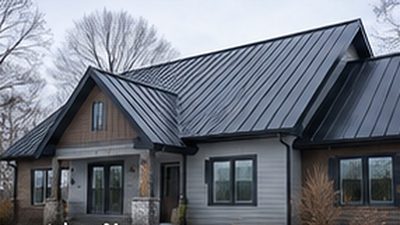
Standing seam, steel shingle, and exposed-fastener roofing installed for the conditions this county actually has: a 50 psf ground snow load, ice at the eaves, and a temperature swing wide enough to move a steel panel three-eighths of an inch.
Four numbers that decide the specification. Every competitor quotes on the panel; these are what the panel has to survive.
Most roofing pitches in this market are about the material. That is the wrong starting point. In Wright County the roof has one hard job for five months of the year: carry a 50 psf ground snow load without letting meltwater find its way backwards under the covering.
That is why the Minnesota code does not simply ask for underlayment at the eave. Under MN Residential Code R905.1.2, an ice barrier has to run from the lowest edge of the roof to a point at least 24 inches inside the exterior wall line — and on a roof of 8:12 or steeper, at least 36 inches measured along the slope. On a house with deep eaves, hitting that line can take two courses of membrane, not one. It is the single most commonly under-installed detail we find on roofs that leak at the ceiling edge.
Steel is not magic. It earns its cost here for three reasons: a smooth panel sheds snow before it can melt and refreeze, a standing seam has no exposed fastener to back out under thermal cycling, and the assembly lasts long enough that you buy it once instead of three times.
Steel expands. Across the temperature range a Monticello roof sees between January and July, a 40-foot run of steel panel changes length by roughly three-eighths of an inch. A standing seam system handles that with concealed floating clips that let the panel slide. Pin the same panel with fixed clips or face screws and that movement has to go somewhere — so it goes into elongated screw holes, oil canning, and seams that open up around year eight.
When you compare bids, this is the line to look for. If a quote does not say which clip type it uses, ask. It is the difference between a 20-year roof and a 50-year one, and it is usually invisible on the invoice.
How standing seam is actually assembled · What it costs in this market
Eight systems. Which one is right depends on your roof's pitch, complexity, and how long you plan to own the house.
Concealed-fastener panels on floating clips. A 40-foot steel panel grows and shrinks about three-eighths of an inch across a Minnesota year — standing seam is built to let it move.
Full tear-off to the deck, or a code-compliant recover over one existing layer. We tell you which one your roof actually qualifies for before you sign anything.
Metal that reads as slate, shake, or architectural shingle from the street. The option for homeowners who want a fifty-year roof without the standing seam look.
Through-fastened panel for pole barns, shops, and outbuildings across rural Wright County — installed with the gasket and torque discipline that decides whether it lasts twelve years or forty.
Seam separation, backed-out fasteners, failed pipe boots, and panel damage — diagnosed on the roof, not guessed at from the driveway.
Ice dams are an attic problem wearing a roof costume. We fix the air leakage, insulation, and intake-to-exhaust balance that actually causes them.
Documented inspections and straight answers on insurance claims — including why any contractor offering to cover your deductible is breaking Minnesota law.
A metal roof sheds snow in slabs, not flurries. Engineered retention above doors, walkways, decks, and driveways so a 50 psf load does not come down all at once.
Four stages, and you know the price before stage three.
We get on the roof and into the attic. Decking, ventilation, existing ice barrier coverage, flashing, prior repairs — photographed and explained.
Panel profile and gauge, clip type, ice barrier coverage, ventilation work, snow retention, and the price. One page, comparable against any other bid.
We file with the City of Monticello Building Safety Department and give you a firm install window. Material is ordered once the permit is in hand.
Landscaping tarped, magnet over the yard nightly, tear-off hauled by us. We book the final inspection and hand you the closed permit.
Four things we will put in writing.
If your roof has eight good years left, that is what the assessment will say. A roof sold early is a roof sold once.
Ice dams, condensation and premature deck rot are ventilation problems. We will not sell you a metal roof over an attic that caused the last failure.
Profile, gauge, clip type, fastener, ice barrier coverage. Specified in writing so you can compare bids on substance.
Monticello, Otsego, Albertville, St. Michael, Clearwater, Big Lake and Becker each have their own building department. We file with all of them.
No sales appointment, no pressure close. Here is the whole sequence, start to finish.
A person picks up during business hours. We ask the age of the roof, what you are seeing, and whether an insurance claim is already open — that last answer changes the whole process. If your roof does not need work yet, we will tell you on the phone rather than book a visit.
We get on the roof where it is safe to, and into the attic — because on a Minnesota house the attic usually explains the roof. We photograph decking condition, ventilation, existing ice barrier coverage, flashing, and any prior repairs. You get the photos whether or not you hire us.
One page, in plain English: panel profile and gauge, clip and fastener type, ice barrier coverage to code, ventilation changes, snow retention if your roof sheds over a door or walkway, and the price. Line items you can compare against another bid without a decoder ring.
We pull the permit. We tarp the landscaping, run a magnet over the yard and driveway at the end of every day, and haul the tear-off ourselves. The final inspection is scheduled by us, and you get the closed permit for your records — it matters when you sell the house.
Questions about any step? Call (763) 342-0499 and ask.
Monticello is home. These six are close enough that we are on site the same week.
Four miles north across the river. Different county, different permit desk, same crew and same drive time as half of Monticello.
Wide lots, long driveways, and more detached shops and pole barns per household than anywhere else we serve.
Otsego shares ZIP 55362 with Monticello — which is exactly why mail, quotes, and insurance paperwork get misrouted here more than anywhere else.
Dense post-1995 subdivisions where roof lines repeat street to street — and where an association may have something to say about panel color.
The most architecturally complex housing stock in our area — steep pitches, multiple dormers, and valley-heavy roofs that punish a careless metal layout.
Open ground west of town along the I-94 corridor, where wind uplift at the eave and rake matters more than it does in a sheltered Monticello cul-de-sac.
Monticello sits on the Mississippi in central Minnesota, and the roofing problems here are seasonal and predictable. Snow accumulates against a code-design ground load of 50 psf. Meltwater refreezes at cold eaves and backs up under the covering. Freeze-thaw movement works at every fastener that is not free to move. Summer hail rolls through on the same convective storm track that crosses the I-94 corridor.
Every one of those is an argument for a continuous, low-friction, mechanically forgiving roof surface — which is the case for metal, stated plainly and without the marketing.
EDCO has manufactured steel roofing and siding in Hopkins, Minnesota since 1946 — material made for this climate, roughly an hour down the highway.
You will not find invented review counts, fabricated award badges, or a made-up availability widget on this site. When we have earned reviews, they will link to a real Google profile. Until then, judge us on the assessment.
For a typical Monticello house, a steel standing seam roof runs roughly $12 to $16 per square foot installed, against about $4 to $7 for architectural asphalt. On a 2,000–2,200 square foot roof that is broadly $28,000 to $45,000 for metal.
The spread is driven by roof complexity, not by the panel. A simple gable costs far less per square foot than a roof with five valleys, three dormers and two chimneys, because the labor is in the flashing, not the field.
No, and any contractor who says otherwise is selling you something. Ice dams form when heat escapes into the attic, melts the underside of the snowpack, and that water refreezes at the cold eave. The roof covering is downstream of the actual problem.
Metal helps at the margin because a smooth, cold panel sheds snow before it can melt and refreeze. But the fix is air sealing, insulation depth, and balanced intake-to-exhaust ventilation. We assess the attic before we quote the roof.
Not on a house. The noise people remember comes from panel screwed directly to open purlins on a barn or shed, with nothing underneath it.
A residential metal roof sits on a solid deck over underlayment, usually with an insulated attic below. Measured sound levels land close to asphalt shingle. If your roof is loud after installation, something was installed wrong.
Sometimes. Minnesota allows a recover over one existing layer if the deck is sound and the existing roof is not water-soaked or badly uneven. It saves tear-off cost and landfill.
We do not recommend it blind. If we cannot verify decking condition, or there are already two layers, or the roof has trapped moisture, it is a tear-off. Covering a bad deck just hides it for twenty years.
Yes. Re-roofing an existing dwelling requires a permit under the Minnesota State Building Code, and Monticello issues them through its online residential permit portal. Inspections need 24 hours' notice.
We pull the permit and schedule the final inspection as part of the job. Keep the closed permit — it comes up at resale, and an unpermitted roof is a negotiating point against you.
A properly installed steel standing seam roof is a 40-to-60-year assembly. Architectural asphalt in this climate is realistically 15 to 20.
The qualifier matters. Metal fails at the details — penetrations, valleys, fastener choice, and whether the installer allowed for thermal movement. The panel almost never fails first.
Talk to a roofer
We walk the roof, photograph what we find, and tell you whether you need a replacement, a repair, or nothing at all this year. If the answer is nothing, we will say so.
(763) 342-0499A person answers — Monday–Friday, 7:00 AM – 6:00 PM · Saturday, 8:00 AM – 2:00 PM
Outside business hours? Call anyway and leave a message — we return them the next working morning.
We walk the roof, photograph what we find, and tell you whether you need a replacement, a repair, or nothing at all this year. If the answer is nothing, we will say so.
A person answers.
Monday–Friday, 7:00 AM – 6:00 PM
Saturday, 8:00 AM – 2:00 PM