
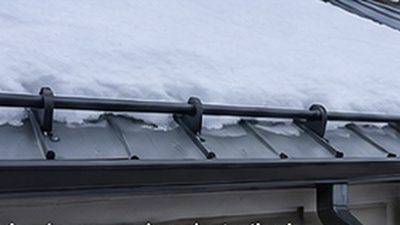
Why this matters more on metal than on asphalt
An asphalt roof holds snow. The granular surface has enough friction that accumulation tends to stay put and melt off gradually. A metal roof does the opposite by design: the surface is smooth, and once a thin film of meltwater forms underneath the snowpack, friction drops away almost entirely.
The result is that a metal roof does not shed snow steadily. It holds a full load, and then releases the whole thing at once, without warning, usually on the first mild afternoon after a cold spell.
Wright County designs to a ground snow load of 50 psf. A modest roof plane — say 12 feet by 20 — can therefore be holding on the order of several tons of snow and ice.
That does not have to arrive on someone's head to matter. It lands on a deck rail, a gas meter, an air conditioning unit, a parked car, or a lower roof. Any of those is an expensive afternoon.
Where retention is genuinely required
- Above every entry door, front, back and service. This is the non-negotiable one.
- Over walkways and paths people use in winter.
- Above decks, patios and steps.
- Over driveways and parking, particularly where a car sits close to the house.
- Above gas meters and utility connections. A sliding load can shear a meter off the wall.
- Over air conditioning condensers and heat pump units.
- Where an upper plane discharges onto a lower roof, which concentrates load exactly where it was not designed for and damages the lower assembly over time.
- Adjacent to a property line where the discharge would land on a neighbor's ground.
The two system types
Bar systems (continuous)
One or more horizontal rails running across the roof plane, carried on brackets. A continuous bar distributes load along its length rather than concentrating it at individual points, which makes it the right choice for steeper pitches, longer runs and heavier loads. It is what we specify for most residential applications in this county.
Pad or cleat systems (individual)
Discrete guards arranged in a staggered pattern across the plane. Lower profile and visually lighter. Appropriate on shorter runs and shallower pitches. The layout matters enormously — a staggered pattern with adequate rows, not a single line of pads, which simply concentrates the load and can tear fixings out.
How they attach — and why standing seam wins here
On a standing seam roof, guards clamp directly onto the seam with set screws. No penetration of the weather surface whatsoever. This is genuinely elegant: you can add, move or remove retention years later without ever making a hole in the roof. It is one of the underrated arguments for standing seam on a house with awkward entries.
On exposed-fastener panel, attachment is through-fastened into purlin or structure, properly sealed. It works, but it adds penetrations to a roof whose weak point is already penetrations.
Adhesive-mounted polycarbonate guards avoid penetration on non-seamed roofs. They can perform well, but only with correct surface preparation and the right adhesive for the coating — and they are less tolerant of decades of thermal movement than a mechanical fixing.
Layout is the whole job
Snow retention is not "put some guards on." The number of rows and their positions depend on roof pitch, the length of the plane from ridge to eave, the design snow load, the panel profile, and what is below. A long steep plane may need two or three rows to break the load up; a short shallow one may need a single bar set well up from the eave.
Guards set too close to the eave are the classic error — they hold mass over the coldest strip of roof and add stress to the eave edge. We lay the system out against the actual plane dimensions and specify it in writing with the rest of the scope.
We install snow retention on new roofs and retrofit it to existing ones across Monticello and the surrounding communities. If your metal roof has already dropped its load once, that is the roof telling you what it needs.