Free metal roof assessments across Monticello and Wright County

Monday–Friday, 7:00 AM – 6:00 PM (763) 342-0499

Metal Roofing Services · Monticello, MN

Metal Roof Repair in Monticello, MN

Most metal roofs that leak do not need replacing. They need the specific thing that failed identified and fixed — which requires somebody getting on the roof.

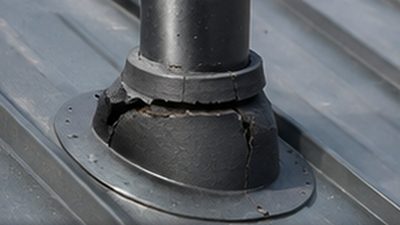
Roofer inspecting a failed pipe boot on a metal roof in Monticello, Minnesota
Pipe boots are the shortest-lived component on most metal roofs. They are also the easiest to fix.

Start with the diagnosis, not the sealant

The default response to a leak on a metal roof is a tube of sealant. It is also why so many roofs around here have three generations of caulk on them and still leak. Sealant is a maintenance material with a service life measured in years, not a substitute for a flashing detail or a fastener that is doing its job.

Water rarely enters where it appears inside. It travels along purlins, rafters and panel ribs before it drops. Finding the actual entry point means getting on the roof and into the attic, in that order.

What we find, and roughly how often

Backed-out or crushed fasteners

The most common failure on any exposed-fastener roof. Screws work loose under thermal cycling, or were over-torqued at install and crushed the washer on day one. The fix is oversized fasteners with new washers, driven to a correct torque. On a roof past fifteen years we usually recommend doing all of them rather than chasing them one at a time — more on why here.

Failed pipe boots

The shortest-lived component on almost every metal roof. The rubber or EPDM collar around a plumbing vent is exposed to UV on all sides and hardens, cracks, and pulls away from the pipe. Ten to fifteen years is a normal life. It is a small, cheap repair and a disproportionately common cause of water in a ceiling.

Seam separation

On standing seam, a seam that has crept open. Nearly always traceable to thermal movement that the original installation did not allow for — fixed clips where floating ones belonged, or a panel pinned at both ends. Repairing the seam without addressing the cause buys a few seasons.

Flashing failures at penetrations and transitions

Chimneys, sidewalls, skylights and valleys. Where somebody used sealant to do a flashing's job, it fails on schedule. The repair is formed metal, not more caulk.

Storm and impact damage

Punctures from falling limbs, panels lifted at an edge by wind, hail dimpling. Cosmetic dimpling on a steel panel is usually not a functional problem. A puncture or a lifted edge is. If insurance is involved, read this first.

When repair is the wrong answer

We will tell you to stop spending if the deck is soft across a wide area, if fasteners are failing everywhere rather than in one region, if the coating has chalked and is rusting at cut edges throughout, or if the roof has already been patched repeatedly in the same place. At that point repairs are a subscription, and replacement is the cheaper path.

How a repair visit runs

  1. Interior first. Where is the water showing, and what is directly above it.
  2. Attic. Staining patterns on the sheathing tell you whether this is a leak, condensation, or ice damming. They look different.
  3. Roof. Fasteners, boots, seams, flashings, valleys, edges — inspected and photographed.
  4. Written findings. What failed, why, what the repair is, and whether repair is genuinely the right call.

You get the photographs either way. If the honest answer is that your roof has eight good years left and needs one boot replaced, that is what the report will say.

Preventive maintenance worth doing

  • Inspect pipe boots every few years. Cheap to replace, expensive to ignore.
  • Re-screw an ag panel roof at 12–20 years, before the washers give out rather than after.
  • Keep valleys clear of needles and leaf litter, which traps moisture against the panel.
  • Check sealant at penetrations, understanding it is a consumable.
  • Watch the eaves in February. Ice building in the same place each winter is an attic problem announcing itself — see ice dam prevention.

We repair metal roofs across Monticello and the surrounding communities in Wright and Sherburne counties.

Metal Roof Repair — questions we get asked

Often not. Two very common look-alikes in this climate are condensation — warm indoor air hitting cold metal or cold sheathing and running — and ice damming, where meltwater backs up under the covering from the eave.

Both produce water inside the building with a roof that is perfectly sound. Sealing the roof harder will not fix either one. The distinction matters because the correct repairs are completely different, and we check for it before quoting anything.

Yes, and most of our repair work is exactly that. We will tell you honestly if what you have is worth repairing.

What we will not do is sell you a patch on an assembly that is failing systemically — if half the fasteners are backing out and the deck is already soft, a repair is rent, not a fix.

It depends entirely on what failed. A pipe boot replacement is a small job. Re-screwing an entire ag panel roof is a day or more of labor plus fasteners. Replacing storm-damaged panels in the middle of a run means unseaming back to the damage.

We diagnose first and quote the actual repair. A price given over the phone for a roof nobody has looked at is a number invented to book a visit.

We will get as close as the manufacturer's current range allows, and we will be straight with you about it. Coatings fade over years of UV, so a brand-new panel in the original color will not be an exact match to a twenty-year-old roof.

Where the mismatch would be conspicuous, replacing a full run rather than a single panel often looks better than a perfect-color patch in the middle of a field.

What actually happens when you call

No sales appointment, no pressure close. Here is the whole sequence, start to finish.

  1. The call

    A person picks up during business hours. We ask the age of the roof, what you are seeing, and whether an insurance claim is already open — that last answer changes the whole process. If your roof does not need work yet, we will tell you on the phone rather than book a visit.

  2. The assessment

    We get on the roof where it is safe to, and into the attic — because on a Minnesota house the attic usually explains the roof. We photograph decking condition, ventilation, existing ice barrier coverage, flashing, and any prior repairs. You get the photos whether or not you hire us.

  3. The written scope

    One page, in plain English: panel profile and gauge, clip and fastener type, ice barrier coverage to code, ventilation changes, snow retention if your roof sheds over a door or walkway, and the price. Line items you can compare against another bid without a decoder ring.

  4. The install and the cleanup

    We pull the permit. We tarp the landscaping, run a magnet over the yard and driveway at the end of every day, and haul the tear-off ourselves. The final inspection is scheduled by us, and you get the closed permit for your records — it matters when you sell the house.

Questions about any step? Call (763) 342-0499 and ask.

Get a straight answer about your roof

We walk the roof, photograph what we find, and tell you whether you need a replacement, a repair, or nothing at all this year. If the answer is nothing, we will say so.

  • Free on-site assessment across Monticello and Wright County
  • Written scope and price before any work begins
  • We pull the permit — you do not
Call now (763) 342-0499

A person answers.
Monday–Friday, 7:00 AM – 6:00 PM
Saturday, 8:00 AM – 2:00 PM

Talk to a roofer

Call and get a straight answer

We walk the roof, photograph what we find, and tell you whether you need a replacement, a repair, or nothing at all this year. If the answer is nothing, we will say so.

(763) 342-0499

A person answers — Monday–Friday, 7:00 AM – 6:00 PM · Saturday, 8:00 AM – 2:00 PM

  • Free on-site assessment Across Monticello and Wright County. You keep the photographs either way.
  • No pressure on the call If your roof has years left, we will tell you on the phone rather than book a visit.
  • We pull the permit Filed with the right authority and the final inspection booked by us.

Outside business hours? Call anyway and leave a message — we return them the next working morning.

Call now Pricing Services