
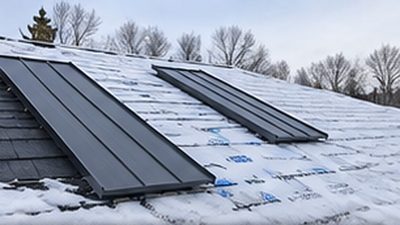
This question arrives every year around the first hard frost, usually from somebody whose roof has just started leaking and who has been told by one contractor that winter work is fine and by another that it is impossible.
Both are oversimplifying. Metal roofing in a Minnesota winter is entirely possible, and it is done routinely. But there is a genuine temperature constraint in the assembly, and it is worth understanding because it is the thing a cut-price winter bid will quietly ignore.
The metal is not the problem
Steel panels do not care about the cold. They cut, form and fasten at 10°F much as they do at 70°F. If anything, metal is the most cold-tolerant roofing material available — unlike asphalt shingles, which become brittle and can crack when handled in the cold, and whose adhesive seal strips will not activate until the sun warms them, sometimes not until spring.
That last point is worth sitting with. An asphalt roof installed in January is not fully sealed in January. It is a roof waiting for warm weather to finish itself. Metal has no equivalent waiting period.
The ice barrier is the problem
Underneath the panels, at the eaves, sits the self-adhering ice barrier membrane that Minnesota code requires — from the lowest roof edge to at least 24 inches inside the exterior wall line, and 36 inches along the slope on pitches of 8:12 and above.
That membrane is rubberised asphalt with an adhesive back. It bonds by sticking to the deck, and adhesives have a minimum working temperature.
Manufacturers specify that self-adhering ice barrier be applied when the air, the deck and the membrane are all at 40°F or above. Most recommend 50°F for a reliable bond.
Below that, the rubberised asphalt stiffens and the adhesive tack drops sharply. Frost, dew or even sawdust on the deck will compromise the bond further.
This is the whole issue. A membrane that has not properly bonded is not a waterproofing layer — it is a sheet of material lying on your deck. And it sits in exactly the band of roof where ice dams form, which is the one place you genuinely need it to work.
How it is done properly in the cold
None of this makes winter work impossible. It makes it deliberate. The established methods:
- Condition the material. Membrane rolls stored at room temperature — around 65°F — for 24 hours before they go on the roof, and kept warm on site rather than left in a truck overnight.
- Prime the deck. Manufacturer-specified primers improve adhesion on cold or marginal substrates.
- Mechanically fasten the membrane where adhesion alone cannot be relied on, following the manufacturer's cold-weather instructions rather than improvising.
- Work the warm part of the day and the sunlit slopes first. A south-facing roof on a clear February afternoon can be well above ambient.
- Clear and dry the deck completely. No frost, no dew, no snow. This is non-negotiable and it is what slows winter work down most.
- Use a high-temperature synthetic underlayment in the field, which is unaffected by cold.
The honest trade-off is productivity. A crew that lays a given area in a day in September will lay appreciably less of it in January, because of daylight, footing, glove work and deck preparation. That is a scheduling reality, not a quality compromise — provided the contractor prices it honestly.
What genuinely should wait for spring
Some work we will actively tell you to postpone:
- Elective replacement of a roof that is still performing. If your roof has two or three winters left in it, there is no argument for doing it in February.
- Extensive attic and ventilation work, where the insulation is disturbed at the point in the year when you most need it.
- Anything requiring an open deck for an extended period. A tear-off that cannot be dried in the same day is a different risk calculation in winter.
- Complex roofs with many valleys and penetrations, where each detail takes longer and the days are shortest.
What should not wait
And some that should not:
- An active leak. Water entering the structure in December will do more damage over a winter than the cold will do to a carefully executed repair.
- Storm damage that has compromised the weather envelope. Get it stabilized, then decide about permanent work.
- A failed pipe boot or flashing. Small, targeted, and far better done than deferred.
The distinction is straightforward: emergencies get handled; elective work gets scheduled for conditions that favor it.
What to ask a contractor offering winter work
If somebody quotes you a January metal roof, these questions will tell you quickly whether they have thought about it:
- "What is your cold-weather procedure for the ice barrier?" The answer should mention temperature, material conditioning, and either priming or mechanical fastening. Vagueness here is the whole answer.
- "How will you ensure the deck is dry before the membrane goes down?"
- "How much roof will you open in a day, and how will you secure it overnight?"
- "Is the manufacturer's warranty affected by installation temperature?" Some product warranties have conditions attached to cold application. You are entitled to know before, not after.
A contractor with an empty schedule in February has an incentive to say yes to work that should wait. If the quote is notably cheap and nobody has mentioned the ice barrier temperature constraint at all, that is not a bargain — it is the part of the roof you cannot inspect being done in conditions the manufacturer does not sanction.
The practical recommendation
If your roof is sound, book the work for spring or late summer and get it done in good conditions at a sensible pace. If your roof is failing, do not spend a Minnesota winter nursing it — get it assessed now, and if the work has to happen cold, make sure it happens cold deliberately.
We assess year-round across Monticello and the surrounding communities, and we will tell you honestly which category you are in. If the answer is "this will hold until April," that is what the report will say — see what else belongs in a written scope.