
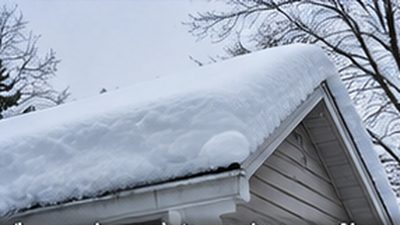
Every few winters Minnesota gets a run of storms that puts a serious load on roofs, and the question follows immediately: is that too much?
Most answers you will find are given in inches, which is the least useful unit available. A roof does not carry depth. It carries weight.
What the code actually designs for
This is where a distinction gets lost that is worth understanding properly, because almost nobody in this trade explains it.
Minnesota sets a ground snow load by county under Minnesota Rules 1303.1700: 60 psf across 29 named northern counties, and 50 psf everywhere else, which includes Wright County and Sherburne County.
The roof design snow load is derived from the ground figure, conventionally about 0.7× it. So a 50 psf ground snow load corresponds to a roof design load in the region of 35 psf.
That is the number your trusses were engineered against. When a contractor tells you your roof "handles 50 psf," they are quoting the ground value — which is the correct figure to cite for the county, but it is not the load on your rafters.
What snow actually weighs
Density varies enormously, which is exactly why depth misleads.
- Fresh dry powder is light. A considerable depth of it may represent only a few pounds per square foot.
- Settled, compacted snow is several times denser than the same snow was on the day it fell.
- Wet snow — the heavy spring kind — is dramatically heavier again.
- Ice is the extreme case. A relatively thin layer of solid ice can outweigh a substantial depth of powder.
For scale: Twin Cities snow depths in the 21-to-26-inch range have been estimated in the region of 4 to 9 psf. Against a roof design load around 35 psf, that is comfortable — which is the reassuring half of the picture.
The unreassuring half is that those figures describe uniform accumulation of ordinary snow. The situations that cause problems are not uniform.
Where load actually concentrates
Roof failures are rare, and when they happen they are almost never a case of even snow on a sound roof. They involve concentration:
- Drifting. Wind redistributes snow into deep local accumulations — against dormers, behind chimneys, in the lee of a higher wall. Open sites like Clearwater see this more than sheltered streets do.
- Valleys. Where two planes meet, snow collects from both and gets nowhere near as much sun.
- Lower roofs beneath higher ones. A porch, addition or attached garage receiving a slide-off from the main roof takes a load it was never designed for. This is the single most common concentration problem we see.
- Rain on snow. A winter rain event on an existing snowpack adds weight fast and is not visible as extra depth.
- Ice dams. Ice accumulating at the eave is both a load and a water problem — and it is telling you something about your attic.
- Long unsupported spans. Older structures, pole barns and machine sheds are more vulnerable than a modern trussed house.
Signs that warrant attention
Structural distress announces itself inside the building before it announces itself outside. Things to take seriously:
- Doors or windows that suddenly stick when they were fine in November. Frame distortion under load.
- New cracks in drywall or plaster, particularly above door frames or where walls meet ceilings.
- Visible sagging of a ceiling or roof line. Sight along the ridge from outside.
- New creaking, popping or cracking under load — distinct from the ordinary noises a cold house makes.
- Sprinkler heads or light fixtures that have shifted relative to the ceiling.
- Doors that pop open on their own.
Get people out of the affected part of the building and call a professional the same day. Do not go up to investigate. Structural assessment under load is not a homeowner task, and a roof showing distress is the worst possible place to be standing.
Clearing snow safely
If accumulation is genuinely heavy — a foot or more of dense, settled snow, or a rain-on-snow event, or drifting into one area — removal is reasonable. Doing it safely matters more than doing it thoroughly.
- Use a roof rake from the ground. Long handle, pull snow down toward you, stand clear of what comes with it.
- Clear the lower few feet first. This is where ice dams form and where the load concentrates at the eave. You do not need to clear the whole roof.
- Work across, not straight down. Pulling a full-height channel can bring a large slab at once.
- Mind what is underneath — gas meters, condensers, shrubs, cars, and people.
- Do not use metal tools on the roof surface. You will damage the covering and the flashing.
- Never chip at ice. Steam removal by a company that does it professionally is the safe option.
- Do not get on the roof. Worth repeating.
The metal roof angle, honestly
A metal roof largely removes this problem by shedding snow before it settles and compacts. On the loading question, that is a genuine advantage, and it is one of the better arguments for metal in this climate.
It substitutes a different problem. Snow that leaves a metal roof leaves suddenly, in a mass, onto whatever is below — which is why snow retention above doors, walkways, decks and driveways is a safety requirement rather than an accessory.
If your metal roof discharges onto a lower roof, that is worth addressing before next winter rather than after.
The short version
- Depth tells you little. Density is everything.
- Wright County designs to 50 psf ground, roughly 35 psf on the roof.
- Uniform snow on a sound modern roof is rarely the problem. Drifts, valleys, lower roofs and rain-on-snow are.
- Watch for sticking doors, new cracks, sagging and unfamiliar noises.
- Rake from the ground. Never climb up.
Concerned about a specific roof — particularly an older outbuilding with a long span? Call (763) 342-0499.