
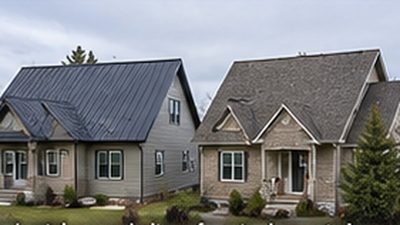
Ask a metal roofing company whether metal is worth it and you will get a yes. Ask an asphalt roofer and you will get a no. Both of them will show you a number that supports their answer, because the answer genuinely does change depending on which horizon you run it over.
So here is the arithmetic, with the working shown, using real ranges for this market. There is a horizon where asphalt wins decisively, and it covers a lot of homeowners.
The starting numbers
Installed cost per square foot in the Monticello and greater Twin Cities market, complete — tear-off, underlayment, ice barrier to code, flashing, trim and disposal:
| System | Per sq ft | Service life |
|---|---|---|
| Architectural asphalt | $4 – $7 | 15 – 20 yrs |
| Steel shingle / stone-coated | $9 – $14 | 40 – 50 yrs |
| Steel standing seam | $12 – $16 | 40 – 60 yrs |
| Aluminum standing seam | $15 – $22 | 50 – 70 yrs |
For a worked example take a 2,200 square foot roof of moderate complexity — a couple of dormers, some valleys, which describes a lot of housing stock in Otsego and Albertville. Using midpoints:
- Architectural asphalt: roughly $13,900
- Steel standing seam: roughly $35,400
Metal costs about 2.5 times more up front. That is the number that ends the conversation for most people, and it should not, because it is only the first of three.
Horizon one: fifteen years
You are in your forties, the kids will be gone in a decade, and you expect to downsize.
Over fifteen years you buy exactly one asphalt roof. It is at the end of its life when you sell, but it is still on the house and still working. Metal costs you $21,500 more and you capture almost none of the extra life you paid for.
Asphalt wins, and it is not close. Anyone telling you otherwise at this horizon is not doing arithmetic.
Horizon two: thirty years
This is where it gets genuinely interesting, and where most of the sales rhetoric falls apart in both directions.
Over thirty years you buy two asphalt roofs — one now, one somewhere around year seventeen. The second one does not cost what the first one did. Roofing costs have historically risen faster than general inflation; assume a conservative 3% annually and your year-seventeen asphalt roof costs roughly $23,000 in then-current money, not $13,900.
So: asphalt totals about $36,900 across thirty years. Metal totals $35,400, once, and has ten to thirty years of life left in it.
On raw outlay they are within a few percent of each other — effectively a tie. But two factors sit outside the arithmetic. In metal's favor: you have a roof with substantial remaining life rather than one that is finished. In asphalt's favor: you kept $21,500 in your pocket for seventeen years, and money you are not spending has value.
Roughly a tie on money. Decide on appearance, on disruption appetite, and on whether you want to manage another roof replacement in your sixties.
Horizon three: fifty years
The family home. You intend to be carried out of it, or to hand it to your children.
Over fifty years asphalt means three roofs: now, year seventeen, year thirty-four. At 3% escalation that is roughly $13,900 + $23,000 + $38,000, or about $74,900.
Metal means one roof at $35,400, possibly a re-coat or minor component work somewhere in the middle, and an assembly that may still be serviceable at the end of the period.
Metal wins by a wide margin — roughly half the lifetime cost, and two fewer weeks of your life spent with your house torn open.
What the arithmetic leaves out
Three things that do not fit in a spreadsheet but should influence the decision.
Disruption has a cost. A roof replacement is several days of noise, debris, vehicles in your driveway and risk to your landscaping. Doing that once instead of three times is worth something real, even though no one can put a number on it.
Insurance may or may not care. Some Minnesota carriers discount for impact-resistant roofing; others rate metal identically to asphalt. Ask your carrier directly before you buy, and treat any discount as a bonus rather than part of the business case. Note too that a growing number of policies carry a cosmetic damage exclusion specifically for metal roofing, which cuts the other way.
Installation quality dominates everything above. Every figure here assumes competent work. A metal roof installed with fixed clips where floating ones belonged, or valleys detailed with sealant instead of formed metal, can fail inside twenty years and turn this entire analysis upside down.
About that 3% assumption
Every figure in the thirty and fifty year cases rests on roofing costs rising about 3% a year. That is deliberately conservative — roofing has historically outpaced general inflation, driven by labor availability and steel and asphalt commodity pricing rather than by the consumer price index.
It is also the assumption most worth arguing with, so substitute your own. At 2% escalation, the second asphalt roof lands near $19,400 instead of $23,000 and the thirty-year comparison tilts toward asphalt. At 5%, it reaches roughly $31,900 and metal wins outright well before year thirty.
The direction of the sensitivity is the useful part: the higher you think future roofing costs will be, the better metal looks, because metal converts an unknown future cost into a known present one. If you have a firm view that roofing will get cheaper in real terms, buy asphalt.
The honest recommendation
- Selling within ten years? Asphalt. Spend the difference on something you will actually experience.
- Staying fifteen to twenty-five years? Genuinely a judgement call. Appearance and disruption tolerance should decide it, not a payback model.
- Staying indefinitely, or this is the family house? Metal, comfortably.
- Budget only reaches a cut-price metal install? Buy good asphalt instead. A well-installed asphalt roof beats a badly installed metal one every time.
Run your own version of these figures on the pricing page, which has a calculator using the same ranges. Then have somebody get on the roof, because the two biggest variables — decking condition and roof complexity — cannot be assessed from the ground.