
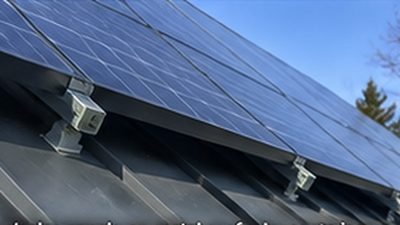
If you are weighing solar and you are also weighing a new roof, the order you do them in matters more than almost any other decision you will make about either — and the roof type you choose determines how the panels attach for the next thirty years.
The penetration problem
On an asphalt shingle roof, mounting a solar array means lag bolts driven through the roof into the rafters. Every mount is a hole through the weather surface, sealed with flashing and sealant.
A residential array might have thirty or forty of them. Each one is a detail that has to be executed correctly and each one is a potential leak in twenty years' time — usually after the installer's workmanship warranty has expired, and often after that company no longer exists.
There is a second problem that gets less attention. Your roof has a 15-to-20-year service life. The array has 25 to 30. So the roof will need replacing underneath a working array, which means paying to remove the whole system, re-roof, and reinstall it.
How standing seam changes it
On a standing seam roof, the raised seams running ridge to eave are structural attachment points that already exist. Mounting hardware clamps directly onto them with round-point setscrews that grip mechanically without piercing anything.
No holes. Nothing through the weather surface. No sealant doing a flashing's job at forty points across your roof.
Because nothing is pierced, the roof manufacturer's warranty generally survives the solar installation intact — which is emphatically not the case with a through-bolted system.
There is a subtler benefit that matters in this climate specifically. A good clamp system is designed not to inhibit the roof's ability to thermally cycle. As covered in how standing seam actually works, a 40-foot steel panel changes length by roughly three-eighths of an inch across a Minnesota year. A mounting system that pinned panels rigidly would fight that movement every single day. Properly specified clamps do not.
Rail-less mounting
Traditional arrays sit on continuous aluminum rails spanning the roof, with panels bolted to the rails. On standing seam, the seams themselves can serve as the rails — panels attach via clamps directly, with no rail system at all.
Manufacturers indicate this can save up to half the material cost, freight and installation time against a railed system. It is also lighter, lower-profile and better-looking from the street, which matters more to most homeowners than they admit.
The sequencing decision
This is the part worth getting right, and it is entirely about arithmetic.
| Your roof's remaining life | What to do |
|---|---|
| Under 10 years | Replace the roof first. Not negotiable. Doing solar now means paying to remove and reinstall it within the array's life. |
| 10–20 years | Strongly consider replacing first. The array will outlast the roof. Do the math on removal and reinstallation cost against replacing now. |
| Over 20 years, or a new metal roof | Proceed with solar. Roof and array are on compatible timelines. |
The cheapest possible sequence, if you are doing both, is roofing immediately followed by solar. The roof is new, the mounting is clean, access is already established, and you never pay to handle the array twice.
Minnesota-specific considerations
Snow shedding into the array
The one genuinely metal-specific risk, and the one most often missed. A metal roof releases its snow load in slabs rather than gradually. A slab traveling down-slope into the lower edge of a panel array represents a real impact load.
The fix is snow retention designed around the array — usually above it, holding the upper load in place. This has to be laid out at the same time as the array, by people talking to each other. Retrofitting retention after a slab has already hit the panels is the expensive way to learn this.
Snow on the panels themselves
Panels produce nothing under snow, and Minnesota winters cost you real generating days. Panels are glass and shed reasonably well once the sun gets at them, and steeper pitches clear faster. Factor a realistic winter production loss into any payback model you are shown — if the model does not mention it, it was not built for this state.
Cold is good for output
Worth knowing as the counterweight: photovoltaic panels are more efficient at lower temperatures. A cold, clear March day with snow reflecting light upward can be an excellent production day. Minnesota is a better solar state than people assume.
What if I already have asphalt and want solar?
This is the most common real-world version of the question, and the honest answer depends entirely on the age of what is up there.
If the shingles are relatively new — say under eight years — mounting solar on asphalt is normal, well-understood work. Thousands of arrays go on asphalt every year and perform fine. The flashed penetrations are a known detail, and a competent installer will execute them properly.
If the roof is past the midpoint of its life, you are making a decision you will pay for twice. An array installed on a 12-year-old asphalt roof will need removing and reinstalling before it is halfway through its own service life, and removal-and-reinstall is not a trivial line item — it can run into several thousand dollars, and it is money that buys you nothing.
That is the moment when replacing with standing seam first becomes the cheaper path overall, even though it looks like the more expensive one on the day. You are buying a roof that outlives the array instead of one the array outlives.
Questions to ask both contractors
- To the solar installer: "Which clamp system, by manufacturer and model, and does it penetrate the panel?"
- To the roofer: "Does this mounting system preserve the roof warranty — in writing?"
- To both: "How is snow retention being handled relative to the array?"
- To both: "Who is responsible if there is a leak at a mounting point?" On a clamped system this should be a short conversation, because there are no mounting penetrations to leak.
- To the solar installer: "What winter production assumption is in this payback model?"
The summary
If you are seriously considering solar in the next decade and you are also facing a roof decision, standing seam is the strongest combination available to you: no penetrations, no warranty conflict, cheaper rail-less mounting, and a roof that will comfortably outlive the array rather than needing replacement underneath it.
We do not install solar. We install the roof it goes on, and we will coordinate with your solar contractor on clamp specification and snow retention layout. Call (763) 342-0499 or see what a metal roof costs here.