
Metal roofing gets sold on being maintenance-free, and it is close enough to true that the marketing is not dishonest. You are not replacing granules, you are not chasing blown-off tabs after every storm, and you are not resealing anything annually.
But "low maintenance" is not "no maintenance," and the parts that do need attention are specific and predictable. Here is the whole list.
The three components with a service life
Start here, because this is most of it. The steel panel will outlast you. These will not.
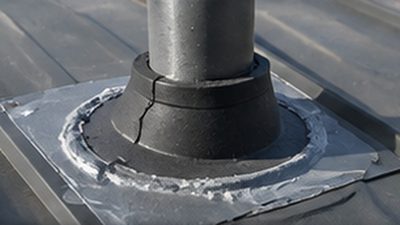
1. Pipe boots — 10 to 15 years
The rubber or EPDM collar sealing around each plumbing vent. It is exposed to UV on every surface, and it hardens, cracks and pulls away from the pipe on a fairly reliable schedule.
This is the single most common cause of a leak on an otherwise sound metal roof. It is also a small, inexpensive repair — provided it is caught before water has been tracking into the deck for three winters.
2. Exposed fasteners — re-screw at 12 to 20 years
Only applies to through-fastened panel — pole barns, shops, outbuildings. Not to standing seam, which has no exposed fasteners at all.
Each screw seals on a rubber washer with a finite life, shortened further if the original installer over-torqued them and crushed the washers on day one. Budget a re-screw with oversized fasteners and fresh washers. Done on schedule it is a modest job; deferred, it becomes deck repair.
3. Sealant — a consumable, not a permanent detail
Wherever sealant appears — at trim, at transitions, around certain penetrations — treat it as something with an expiry date rather than part of the structure.
Critically: sealant should be supporting a flashing detail, never substituting for one. If sealant is the only thing keeping water out somewhere on your roof, that is a design problem rather than a maintenance one.
Seasonal checklist
Nearly all of this is done from the ground with a pair of binoculars. That is deliberate — see the safety note below.
Fall, before the snow
- Clear valleys and behind chimneys of leaves and needles. Trapped debris holds moisture against the panel and dams meltwater.
- Clear gutters and downspouts. A blocked gutter contributes directly to ice at the eave.
- Check pipe boots with binoculars for visible cracking or lifting.
- Trim overhanging branches. Wind-driven limbs scratch coatings, and a heavy limb under ice load is a puncture.
- Look at ridge and rake trim for anything lifted or loose — especially on exposed sites.
- Check snow retention is present and secure above doors, walks, decks and drives.
Winter, during
- Watch the eaves for ice. Ice building in the same place each year is your attic telling you something — not your roof.
- Note where snow discharges. If slabs are landing somewhere they should not, that is next summer's retention job.
- Rake the lower few feet from the ground after heavy accumulation, if needed — how much is too much.
- Check the attic on a cold morning for frost on the underside of the sheathing. Frost means moist air is getting up there.
Spring, after the thaw
- Walk the perimeter and look for anything that came off over winter — trim, closure strips, fasteners on the ground.
- Look for new dents after any hail event. On steel, dimpling is usually cosmetic; a puncture or fractured coating is not — the distinction matters for a claim.
- Check ceilings inside for staining that appeared over winter.
- Inspect sealant at visible details for cracking or separation.
- On unheated outbuildings, check for condensation staining on the underside of the panel — which is not a leak and will not respond to sealant.
Summer
- The re-screw window for exposed-fastener roofs approaching year twelve.
- Attic and ventilation work, which is warm-weather work and much cheaper done alongside any roof work.
- Clean panels if needed, gently — see below.
Things that will damage a metal roof
- Pressure washing. Drives water backwards under laps and seams, and damages the coating.
- Walking on it carelessly. If you must, step over a supported line, never mid-pan, and never on a wet, frosty or snow-covered panel.
- Metal snow tools or ice chipping. Gouges the coating; once the coating is breached at a scratch, corrosion has a starting point.
- Harsh or abrasive cleaners. Mild detergent, soft brush, low pressure, working down-slope.
- Dissimilar metals in contact. Copper against steel, or the wrong fastener alloy, causes galvanic corrosion. This includes the drips from a copper vent above a steel panel.
- Mounting anything by drilling. Satellite dishes, lights, holiday decorations. On standing seam there are clamp-on attachments that need no penetration at all — the same principle that makes solar work so well on this roof type.
When to call somebody
- Water showing inside, anywhere.
- Visible seam separation or a lifted panel edge.
- Fasteners visibly backing out across a whole slope rather than in one spot.
- After hail or a significant wind event, for documentation whether or not you claim.
- Rust at cut edges or at fasteners.
- Any concern that would otherwise involve you getting on the roof.
A note on safety, meant seriously
This checklist is deliberately written to be done from the ground. Falls are the leading cause of serious injury in roofing, and a metal roof is slicker than an asphalt one — dramatically so when wet, frosty or dusty.
Nothing on your roof is worth a fall from it. If something needs a closer look, that is what we are for, and the assessment is free.
The realistic summary
Over fifty years of standing seam ownership, the maintenance is roughly: keep the valleys clear, replace pipe boots two or three times, refresh sealant at details occasionally, and have somebody look at it every few years and after storms.
That is genuinely light. It is not nothing, and the gap between those two is where most premature metal roof failures live.
We inspect and repair metal roofs across Monticello and the surrounding communities, including roofs we did not install — what that involves.